This website uses cookies so that we can provide you with the best user experience possible. Cookie information is stored in your browser and performs functions such as recognising you when you return to our website and helping our team to understand which sections of the website you find most interesting and useful.
Language:
This year’s Fairwork Bangladesh report finds concerns around unfair working conditions persist

PC: Yasin Hasan, Shutterstock
This year’s Fairwork Bangladesh report evaluates working conditions at 9 digital labour platforms: Chaldal.com, Foodpanda, Hello Task, HungryNaki, Obhai, Pathao, Sheba XYZ, Truck Lagbe, and Uber.
In their second round of research, Fairwork Bangladesh at DataSense has assessed platforms based on five principles of Fairwork: fair pay, conditions, contracts, management, and representation.
The report contains a few noteworthy findings: a) There is a lack of awareness among the workers about the minimum wage and living wage, b) workers spend many non-earning hours on the platform, and c) there is an absence of strong collective action among workers across all the platforms. During interviews with workers, the team also uncovered a new phenomenon: “Khaep” or “workers going solo” – where many ride-sharing workers directly interact with consumers, completely bypassing the platform. By doing so, workers are challenging the high commissions platforms charge for workers’ services.
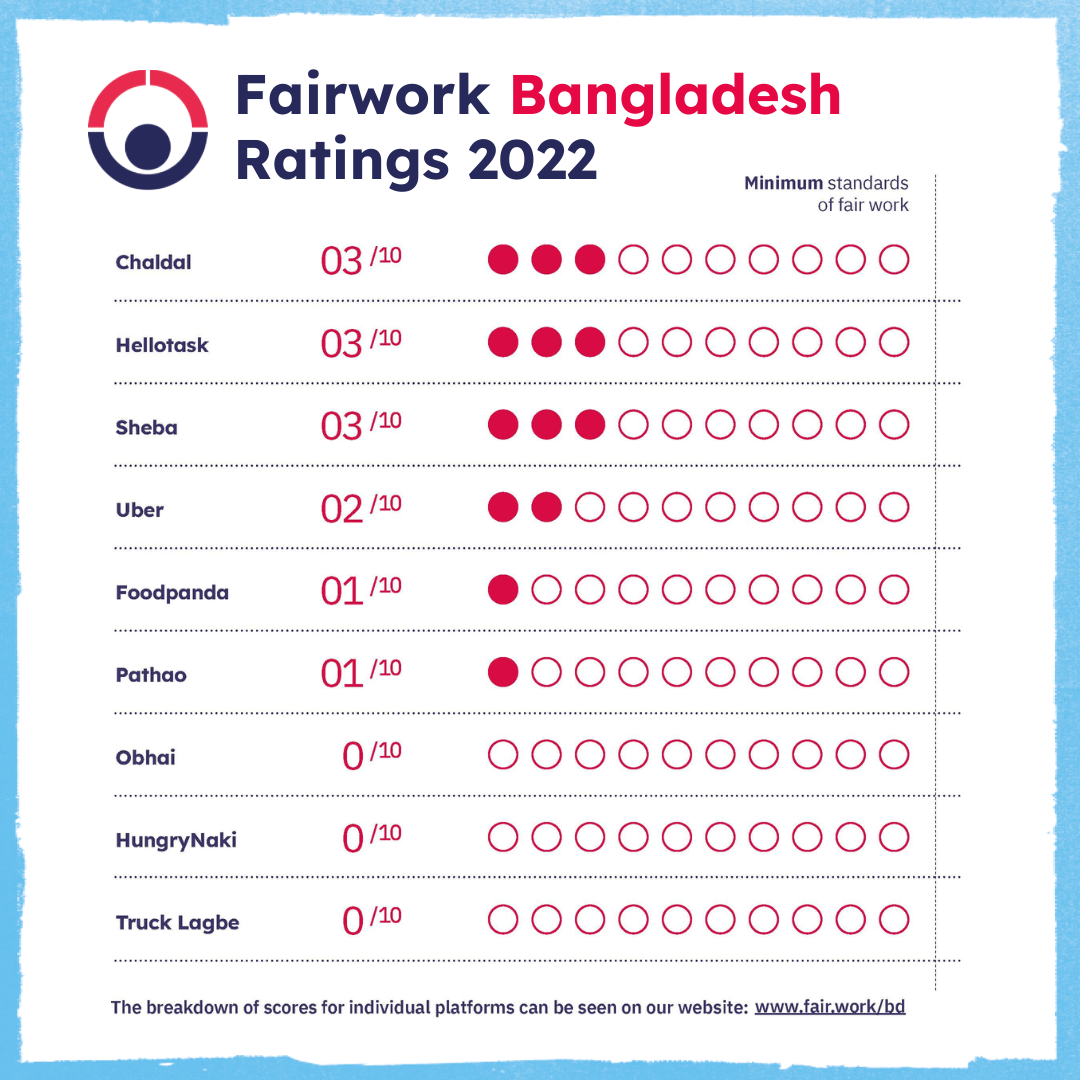
In 2022, the highest score awarded to the platforms is 3 out of 10, achieved by Sheba XYZ, HelloTask and Chaldal.com. They are followed by Uber at 2, FoodPanda and Pathao at 1, and Obhai, HungryNaki, and Truck Lagbe at 0. Generally, most Bangladeshi platforms could be doing much more for their workers. Among other solutions, platforms should provide better insurance policies, establish proper wage structures, and create more just contractual relationships with workers.
Ratings
Key findings
Fair Pay: Although none of the platforms evaluated this year offer a wage guarantee, workers interviewed from Sheba and Hellotask told the team they make the minimum wage. Overall, massive variation was found in the earnings of gig workers, both within and between platforms.
Fair Conditions: Although most of the platforms evaluated could evidence some measures to protect workers from work-related risks, only two platforms — Chaldal and Pathao — could evidence the criteria necessary to score a point for principle 2.1. Of the 91 workers interviewed, 51 reported a lack of safety measures.
Fair Contracts: The contractual status of many platform workers interviewed remains ambiguous — half of them reported not receiving a contract for work, while around two-thirds recalled accepting the terms and conditions.
Fair Management: The platforms evaluated were generally found to have a human-centric call center that workers could rely on for support with work-related issues.
Fair Contracts: No platform received a point for either principle 5.1 or 5.2. There is no gig workers’ union that covers all the workers in Bangladesh’s platform economy.
What can I do? Fairwork Pledge
As part of Fairwork’s commitment to making platforms accountable for their labour practices, we have launched the Fairwork Pledge. This pledge aims to encourage other organisations to support decent labour practices in the platform economy, guided by the five principles of fair work.
Organisations like universities, schools, businesses, investors and charities that make use of platform labour can make a difference by supporting platforms that offer better working conditions.
Organisations have the option to sign up to the Pledge as an official Fairwork Supporter or an official Fairwork Partner. Those signing up to be a Supporter must demonstrate their support for fairer platform work publicly and provide their staff with appropriate resources to make informed decisions about what platforms to use. Becoming a Fairwork Partner entails making a public commitment to implement changes in their own internal practices, such as committing to using better-rated platforms when there is a choice.
The Oxford Internet Institute, The University of Oxford School of Geography and the Environment, The Church of England Diocese of Oxford, the Good Business Charter, The New Economics Foundation and Meatspace Press have already signed the pledge. Join them in demanding a fairer future of work!