First Fairwork Poland report exposes labour practices of leading platforms at a pivotal moment

The first-ever Fairwork Poland report sheds light on pressing issues in the country’s platform economy. The report highlights challenges related to companies’ use of complex contractual frameworks, labour intermediation, and the implications of both for workers’ rights and social security. In light of the newly implemented European Platform Work Directive, these findings offer a timely lens on the future of gig work in Poland and beyond.
This landmark study evaluates six major players in Poland’s platform economy—Bolt, Glovo, Freenow, Pyszne.pl/Just Eat Takeaway, Uber, and Uber Eats—against Fairwork’s five principles: fair pay, fair conditions, fair contracts, fair management, and fair representation. It finds none able to evidence a minimum standard of fair work according to this criteria.
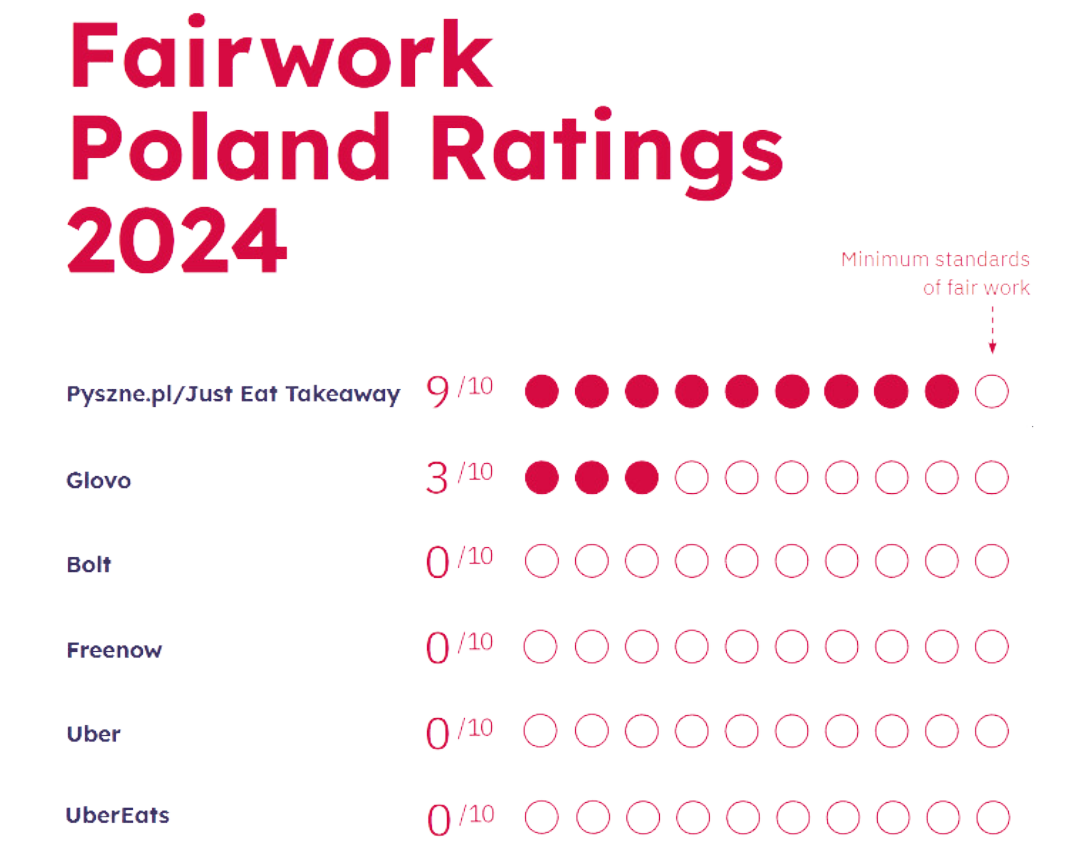
The Fairwork scores were determined through rigorous desk research, worker interviews, and platform-submitted evidence. The worker interviews were collected by students in sociology during Karol Muszyński’s courses at the University of Warsaw. It was authored by by Karol Muszyński (University of Warsaw), Zuzanna Kowalik (University of Warsaw, Institute for Structural Research), Tobias Kuttler (WZB Berlin Science Centre) and Mark Graham (Oxford Internet Institute).
Learn more about the Fairwork methodology here.
Key Findings
- FAIR PAY: Among the six platforms, Pyszne.pl/Just Eat Takeaway stands out as the sole provider of pay above Poland’s statutory hourly minimum rate. By employing couriers on civil law contracts, it ensures a living wage for full-time equivalent workers. In stark contrast, the other platforms rely on algorithm-driven pay structures that fail to guarantee minimum earnings.
- FAIR CONDITIONS: Only Pyszne.pl/Just Eat Takeaway meets the standard for providing comprehensive protection against work-related risks and accidents. While Glovo offers some additional insurance and protective gear, it was unable to demonstrate the provision of free delivery bags for its workers, leaving it short of full marks. Other platforms, including Bolt, Freenow, Uber, and Uber Eats, were unable to evidence sufficient health and safety measures to score these points.
- FAIR CONTRACTS: Transparent and accessible contracts were confirmed for Pyszne.pl/Just Eat Takeaway and Glovo. However, neither was able to evidence full social security access for their workers, as sick leave remains optional. The remaining platforms were unsuccessful at demonstrating sufficient clarity in their contractual terms or processes for supervising intermediaries.
- FAIR MANAGEMENT: All platforms facilitate worker communication with human representatives, but only Glovo and Pyszne.pl/Just Eat Takeaway were able to evidence robust anti-discrimination policies and due process mechanisms. Significant improvements in this area are needed across the board to ensure fair treatment of workers.
- FAIR REPRESENTATION: Disappointingly, most platforms in Poland failed to evidence a willingness to integrate workers into decision-making processes. However, Pyszne.pl/Just Eat Takeaway, emerged as an industry leader in this regard by recognising and engaging in negotiations with a trade union.
Looking Ahead
As platform work continues to grow, the Fairwork Poland 2024 Report serves as a wake-up call for policymakers, platforms, and workers alike. With the European Platform Work Directive set to reshape the gig economy, the report’s findings underscore the urgent need for better practices and stronger protections.