Latest report offers first insights into impacts of Chile’s new platform law

This first comprehensive analysis of working conditions in the Chilean platform economy since the enactment of new regulations on gig work in the country shows few improvements in the fairness of work in this sector. “Fairwork Chile Ratings 2024: Labour Standards in the Platform Economy”—the third report of its kind from Fairwork—reveals that many companies still fail to evidence basic fair labour standards.
Law No. 21.431, which has been in effect since September 1, 2022, has significantly altered the criteria for assessing working conditions in the Chilean platform economy by setting minimum standards for working hours, remuneration and access to social security; however, according to the findings of this report, there are still many areas where more evidence is needed to ensure that the platform economy in Chile is fair for workers. At least until the second quarter (April-June) of 2023, the law did not appear to have reduced the rate of informality in the digital economy.
Given the growth in Chile’s platform economy in recent years, the conditions of work in this sector are impacting an increasing number of Chileans. According to the most recent statistics from the National Statistics Institute (INE), 2.3% of the country’s total workforce is employed in the gig economy. In April-June 2024, 53,712 people declared jobs carried out through digital platforms as their main occupation. Most of these workers are in the Santiago Metropolitan Region, where a significant amount of this research was carried out.
Watch the Report Launch:
Key findings
The Fairwork Chile Scores 2024 assess nine companies operating in the country, including the most popular transportation (Cabify, Uber, Didi, inDrive) and delivery platforms (Cornershop now Uber Eats, Justo, PedidosYa, Rappi). These applications were analysed under Fairwork’s five principles: fair pay, fair conditions, fair contracts, fair management and fair representation.
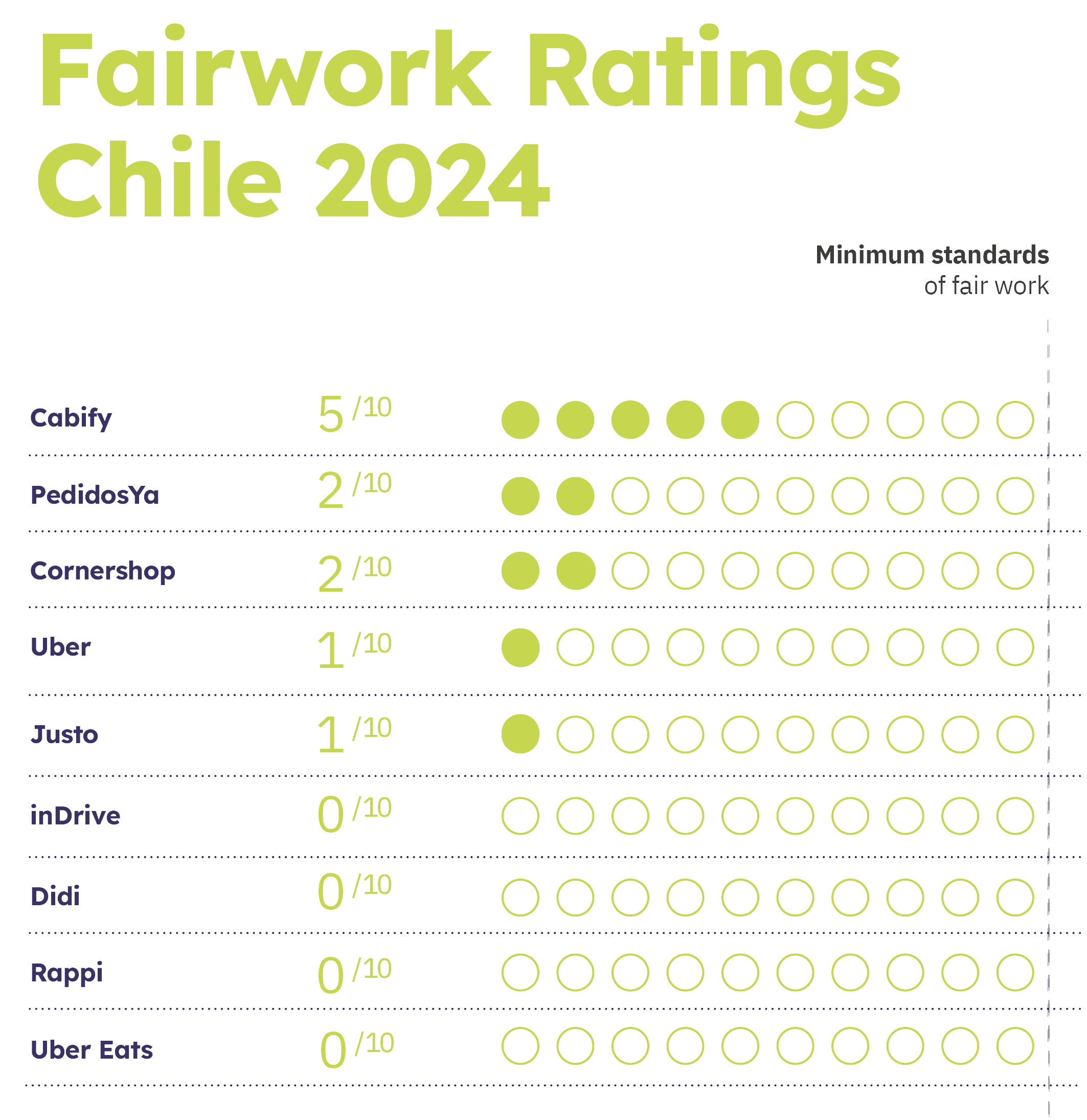
Fair pay: Cabify is the only platform that demonstrated that its workers earn more than the Chilean minimum wage (CLP 460,000 per month, CLP 2,380 per hour) and the local living wage (CLP 782,549 per month, CLP 4,516 per hour). The eight other platforms assessed did not provide sufficient evidence to demonstrate that their workers earn at least the minimum or living wage after costs.
Fair conditions: Three platforms scored points for improving workplace safety by introducing panic buttons and exclusion areas.
Fair contracts: Five platforms have contracts that include notice periods for changes in their terms and conditions and are free of clauses that exempt the platform from liability or require waivers of legal rights.
Fair management: Only Cabify scored points on this principle. Most platforms have poor communication channels and lack appeal procedures and transparency on algorithmic decisions. Cabify is the only one with anti-discrimination policies.
Fair representation: Unfortunately no platform scored points for this principle. There was insufficient evidence of recognition or facilitation of workers’ organisations or collective bargaining. Informal associations exist, but there are no formal mechanisms of representation to influence labour decisions.
This year’s ratings show mixed results, especially after the implementation of the regulation.
Arturo Arriagada, the lead author of this report, academic at the Adolfo Ibáñez University and senior researcher at the Millennium Nucleus on the Evolution of Work, says: “It is essential that digital platforms adopt fair labour practices that not only minimally comply with national laws, but also promote a fair and equitable working environment for all those who are part of this economy, from workers to end consumers.
Recommendations
The report concludes that while there have been some improvements in the working conditions of digital platform workers in Chile, significant challenges remain. It recommends that digital platforms:
- Implement fair remuneration policies: Ensure that all workers receive at least the minimum wage after deducting costs related to their work.
- Improve working conditions: Implement additional measures to ensure the safety and well-being of workers. Platforms need to strengthen efforts to mitigate health and safety risks.
- Clarify contracts: Provide clear and fair contracts that properly define the employment relationship.
- Transparency in management: Improve transparency and dispute resolution mechanisms for workers.
- Facilitate worker representation: Enable and facilitate collective representation and structured dialogue with workers.
For more information, please contact Valentina Justiniano, Communications Officer, School of Communications and Journalism, Universidad Adolfo Ibáñez at valentina.justiniano@uai.cl.